INTRODUCTION
This report gives an introduction to the Laurentian Library in Florence, Italy. Established by the Medici family in the 15th century, originally through the efforts of the bibliophile and scholar Cosimo de’ Medici and added to by his descendants, the library was built to emphasize that the Medici family were no longer mere merchants but members of intelligent & ecclesiastical society. The library’s great claim to fame is the exceptional character of the manuscripts & books, many of which are of medieval & early Renaissance origin, & it is considered the most important & prestigious collection of antique books in Italy.
The library, built in a cloister of the Medicean Basilica di San Lorenzo di Firenze, is referred to as the Laurentian library (Biblioteca Laurenziana) after the patron saint of the San Lorenzo church. The mission of the library (from the official library website - see references) is “The Biblioteca Medicea Laurenziana... is an international research library specializing in the conversation and study of its manuscript and rare book collections”. Another important facet of the collection was that it provided knowledge from a source other than the church.
However, it is not just the collection that draws the thousands of visitors every year to the library. The Medici Popes - Leo X and Clement VII were responsible for commissioning Michelangelo to plan and build the library in its current location. Michelangelo and various other architects, builders and artisans are responsible for the vestibule and reading room. Of particular architectural significance is the staircase leading from the vestibule to the reading room, which flouted conventions of the day & produced a period of architectural experimentation, known as Mannerism, that eventually evolved into the Baroque. It has been described as one of the most original and fluid staircases in the world.
HISTORY
HISTORY
Though Florence (Firenze in Italian) can lay claim to a modest importance in the ancient world, it did not fully emerge into its own until the C11. In the early 1200s, the city, like most of the rest of Italy, was rent by civic unrest. Two factions, the Guelphs & the Ghibellines competed for power. The Guelphs supported the papacy, & the Ghibellines supported the Holy Roman Empire. Bloody battles tore Florence & other Italian cities apart. Sometimes the Guelphs were in power & exiled the Ghibellines, at other times, the reverse was true. By the end of the C13 the Guelphs ruled securely & the Ghibellines had been vanquished. This didn’t end civic strife, however - the Guelphs split into the Whites & the Blacks for reasons still debated by historians. Dante, author of the Divine Comedy (arguably Italy’s greatest work of literature) was banished from Florence in 1301 because he was a White.
Local merchants had organized themselves into guilds by 1250. In that year they made a landmark attempt at elective, republican rule. Though the episode lasted only 10 years, it constituted a breakthrough in Western history. Such a daring stance by the merchant class can be attributed to its new-found power, as Florence was emerging as one of the economic powerhouses in C13 Europe. Florentines were papal bankers; they instituted the system of international letters of credit; & the gold florin became the international standard of currency. With this economic strength came a building boom. Public & private palaces, churches, & basilicas were built, enlarged or restructured. Sculptors such as Donatello & Ghiberti were commissioned to decorate them; painters such as Giotto & Botticelli were commissioned to fresco their walls.
Though ostensibly a republic, Florence was blessed (or cursed, depending on your point of view) with one very powerful family, the Medici, who came to prominence in the 1430s & were the de facto rulers of Florence for several hundred years. The city flourished in the C15, when, under the leadership of the brilliant & shrewd Cosimo de’ Medici (or Cosimo the Elder), it became the most important centre of artistic & intellectual achievement since the Classical era. The Medicis, who came from middle-class origins to produce Popes, Queens & powerful Dukes, oversaw Florence’s most prominent periods. With money to spare, the family supported the arts, amassing grand collections while nurturing the masters. Cosimo was patron to Donatello, Ghiberti & Brunelleschi. His grandson, the charismatic Lorenzo the Magnificent, supported Botticelli & the young Michelangelo; Lorenzo’s son Pope Leo X, is known both for commissioning Raphael & excommunicating Martin Luther. Florence produced “Renaissance men” in the arena of political thought as well. Machiavelli’s The Prince, penned in an attempt to regain favour with the Medici clan when he was charged with conspiracy, praised their cold brutality & willingness to torture; his masterpiece is the source of the hardball political philosophy that the “ends justify the means”. Lorenzo’s son, Piero (1471-1503) proved inept at handling the city’s affairs. He was run out of town in 1494, & Florence briefly enjoyed its status as a republic while dominated by the Dominican friar Girolamo Savanarola (1452-98). Savonarola preached against perceived pagan abuses & persuaded his followers to destroy their books, art, women’s wigs & jewellery in public “bonfires of the vanities”. Eventually, he so annoyed the Pope that he was declared a heretic & hanged.
After a decade of internal unrest, the republic fell & the Medici were recalled to power. But even with the return of the Medici, Florence never regained its former prestige. By the 1530s most of the major artistic talent had left the city – Michelangelo, for one, had settled in Rome. The now-ineffectual Medici, eventually attaining the title of grand Dukes, remained nominally in power until the line died out in 1737, after which time Florence passed from the Austrians to the French & back again until the unification of Italy (1865-70), when it briefly became the capital under King Vittorio Emanuele II (1820-78).
THE PEOPLE
Wikipedia, the free Encyclopedia, 2011, Galileo Galilei, Wikipedia, the free Encyclopedia, viewed 29 September 2011,
THE PEOPLE
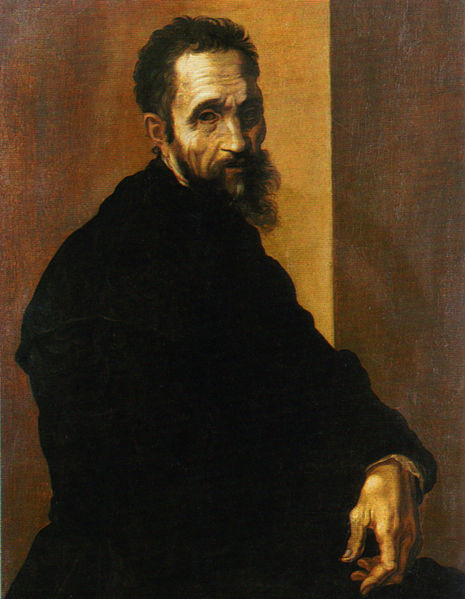
MICHELANGELO BUONARROTI (Michelangelo) (1475-1564) - architect, sculptor, poet & painter, was born in the small & remote village of Caprese, in the mountains about 90km east of Florence. His family moved to Florence soon after his birth & settled there permanently.
He started his artistic career with a (late) apprenticeship with Ghirlandaio, at around 13, but left within a year, partly because he had nothing to learn & partly because he was showing a marked preference for sculpture (a bias that remained with him all his life).
Michelangelo quickly found himself in a charmed circle, working with a group of artists sponsored by Lorenzo the Magnificent. It was his first brush with patronage, a system whose constant demands – those of the Popes in Rome, those of the Medici in Florence – were to prove a source of lifelong frustration. Many of his works remained unfinished because of it.
At the same time, Michelangelo could be his own worst enemy. His personal habits were repulsive; he was consumed by worry, desperate to accumulate property, jealous of other artists & overambitious.
Fate was no kinder as political turmoil frequently intervened to disrupt his work. One such upheaval, the Medici’s exile in 1494, saw him leave Florence for Bologna. A little later he was in Rome where he produced Bacchus (Bargello), his earliest surviving large-scale sculpture (c1497). A year later, still in Rome, came the work which secured his reputation: the Pieta (1498), now in Rome’s St. Peter’s. The Accademia’s David, sculpted on his return to Florence in 1501, consolidated his position. This Florentine interlude also produced the Uffizi’s Doni Tondo, one of his rare excursions into easel painting. In 1505, he started work on murals in the Palazzo Vecchio (of which only copies survive) & also began a set of 12 Apostles for the Duomo (of which only the Accademia’s St. Matthew was ever started). Both projects were abandoned so that he could work on the tomb of Pope Julius II in Rome – a proposed 40-figure sculpture that distracted him intermittently for almost 50 years. Soon after he began that project came his most famous commission, the painting of the Sistine Chapel (1508-12).
By 1516, he was back in Florence, dispatched by Leo X (a Medici Pope) to work under the Pope’s cousin, Cardinal de’Medici (later Pope Clement VII). During this period though turning increasingly to architecture, he embarked on San Lorenzo’s Medici tombs (1523-33), yet another unfinished work. Chastened by the Republic’s overthrow, he also helped to design the city fortifications before the siege of Charles V.
Michelangelo finally left Florence in 1534 & spent the rest of his days in Rome. During this period he wrote the best of his 300 or so poems. He also painted the Sistine Chapel’s Last Judgment (1534-41), its tone more subdued than that of his earlier work in the vaults.
Architecture again dominated as old age encroached; Piazza del Campidoglio & the dome of St. Peter’s were the 2 great works of his later years. Two tortured sculptures also materialized, one of which – the Pieta in the Museo dell’Opera del Duomo – was intended for his tomb. He died at the age of 88 & was buried in Florence’s Santa Croce.
(Michelangelo also was the architect of the Biblioteca Medicea Laurenziana (Laurentian Library). Here it is almost as if Michelangelo purposely set out to defy his predecessors, intentionally flouting the conventions of the High Renaissance to see what kind of bizarre, mannered effect might result. His innovations were extremely influential & produced a period of architectural experimentation, known as Mannerism, that eventually evolved into the baroque.)
MICHANGELO IN FLORENCE
Sculpture – Madonna della Scala, Battle of the Centaurs, Torso (Casa Buonarroti)
Bacchus, Madonna & Child tondo, Brutus (Bargello)
David, St. Matthew, Four Slaves (Accademia)
Lorenzo, Dawn & Dusk, Giuliano, Day & Night, Madonna & Child (Cappelle Medicee)
Pieta (Museo dell’Opera del Duomo)
Architecture – Sagrestia Nuova (Cappelle Medicee)
Biblioteca Laurenziana (San Lorenzo)
Paintings & drawings – Doni Tondo (Uffizi)
Drawings (Casa Buonarroti)
Graffiti & wall drawings (attributed to Michelangelo; Sagrestia Nuova, Cappelle Medicee).
THE MEDICI FAMILY
The Medici family of bankers & merchants founded a dynasty that in effect ruled Florence (& later all of Tuscany) for most of the period between 1434 & 1737. The Medicis first arrived in Florence around 1200 from the Mugello region, north of Florence. During the thirteenth century the city of Florence became increasingly famous & prosperous due to its success in the cloth & woolen trade, but also became increasingly divided between those who supported the Pope, the Guelphs, & those who supported the Holy Roman Empire, the Ghibellines. Success in commerce & trade led to the creation of trade guilds, among which was the guild of bankers. The Medicis made their fortune & achieved their status in the banking business & within the greater guilds of Florence. And, for the most part, the Medicis aligned themselves with the interests of the papacy.
The family fortune was established by Giovanni de’Medici (1360-1429) who founded the Medici bank, which was one of the most prosperous and respected institutions in Europe. On his death the business was passed onto his son, Cosimo (1389-1464), also known as Cosimo the Elder, under whose leadership the bank became a network of twenty two branches spreading from London to Naples. (A notable contribution to the profession of accounting was the improvement of the general ledger system through the development of the double entry bookkeeping system for tracking debits & credits. This system was first used by accountants working for the Medici family in Florence.) There are some estimates that the Medici family were the wealthiest family in Europe at this time. Like his father, Cosimo kept a low profile in politics being gondfalonier (standard bearer of Justice, a position held for just 2 months) only once. However, he did control a large party of supporters & the populace liked him because he was not obviously extravagant & much of his patronage of the arts, as at San Marco & San Lorenzo benefited the public. It is also suggested that as the Medici family were connected to most other elite families of the time through marriages of convenience, partnerships or employment, thus encouraging the rise of the Medici family. Under Cosimo, the Medici became bankers to the Papacy. In 1433 Cosimo was exiled following a plot by the Strozzi, Brancacci & Abizzi families, who complained bitterly that he wielded too much power. Cosimo’s guidance & the stability that his bank gave to the city were greatly missed by the Florentines, however, & a year later he returned in triumph. Cosimo's claim to greatness, however, rests chiefly on his generosity toward artists and scholars. He founded the famous Medici Library and an academy for Greek studies (headed by Marsilio Ficino), built extensively in Florence, and protected such artists as Brunnelleschi, Donatello, Ghiberti, and Luca della Robbia. He also influenced learning through his support of both humanistic education & the creation of the Europe’s first public library at the monastery of San Marco in Florence. This library was dedicated primarily to housing classical and early Christian manuscripts. It is said that Cosimo’s social equals praised his qualities of magnanimity & the way in which he combined a devotion to learning with an active & conscientious concern for public affairs. His book-collecting enthusiasm can be traced back to at least 1418. Cosimo had two sons, Piero (1416–1469) and Giovanni (1421–1453). Piero suffered throughout his life with a severe case of gout and served as head of the family only briefly (1464–1469) after Cosimo’s death. It was Piero’s son Lorenzo, however, who assumed leadership of the family from 1469 and who came to be called il Magnifico, the magnificent.
THE MEDICI FAMILY
The Medici family of bankers & merchants founded a dynasty that in effect ruled Florence (& later all of Tuscany) for most of the period between 1434 & 1737. The Medicis first arrived in Florence around 1200 from the Mugello region, north of Florence. During the thirteenth century the city of Florence became increasingly famous & prosperous due to its success in the cloth & woolen trade, but also became increasingly divided between those who supported the Pope, the Guelphs, & those who supported the Holy Roman Empire, the Ghibellines. Success in commerce & trade led to the creation of trade guilds, among which was the guild of bankers. The Medicis made their fortune & achieved their status in the banking business & within the greater guilds of Florence. And, for the most part, the Medicis aligned themselves with the interests of the papacy.
The family fortune was established by Giovanni de’Medici (1360-1429) who founded the Medici bank, which was one of the most prosperous and respected institutions in Europe. On his death the business was passed onto his son, Cosimo (1389-1464), also known as Cosimo the Elder, under whose leadership the bank became a network of twenty two branches spreading from London to Naples. (A notable contribution to the profession of accounting was the improvement of the general ledger system through the development of the double entry bookkeeping system for tracking debits & credits. This system was first used by accountants working for the Medici family in Florence.) There are some estimates that the Medici family were the wealthiest family in Europe at this time. Like his father, Cosimo kept a low profile in politics being gondfalonier (standard bearer of Justice, a position held for just 2 months) only once. However, he did control a large party of supporters & the populace liked him because he was not obviously extravagant & much of his patronage of the arts, as at San Marco & San Lorenzo benefited the public. It is also suggested that as the Medici family were connected to most other elite families of the time through marriages of convenience, partnerships or employment, thus encouraging the rise of the Medici family. Under Cosimo, the Medici became bankers to the Papacy. In 1433 Cosimo was exiled following a plot by the Strozzi, Brancacci & Abizzi families, who complained bitterly that he wielded too much power. Cosimo’s guidance & the stability that his bank gave to the city were greatly missed by the Florentines, however, & a year later he returned in triumph. Cosimo's claim to greatness, however, rests chiefly on his generosity toward artists and scholars. He founded the famous Medici Library and an academy for Greek studies (headed by Marsilio Ficino), built extensively in Florence, and protected such artists as Brunnelleschi, Donatello, Ghiberti, and Luca della Robbia. He also influenced learning through his support of both humanistic education & the creation of the Europe’s first public library at the monastery of San Marco in Florence. This library was dedicated primarily to housing classical and early Christian manuscripts. It is said that Cosimo’s social equals praised his qualities of magnanimity & the way in which he combined a devotion to learning with an active & conscientious concern for public affairs. His book-collecting enthusiasm can be traced back to at least 1418. Cosimo had two sons, Piero (1416–1469) and Giovanni (1421–1453). Piero suffered throughout his life with a severe case of gout and served as head of the family only briefly (1464–1469) after Cosimo’s death. It was Piero’s son Lorenzo, however, who assumed leadership of the family from 1469 and who came to be called il Magnifico, the magnificent.
Lorenzo the Magnificent (1449–1492) was only twenty years old when he assumed his duties as both head of the Medici family and shaper of Florentine policy. Following his grandfather Cosimo’s lead, Lorenzo dedicated himself to assisting the rising generation of young artists and scholars. Indeed Lorenzo was an artist in his own right, and author of poetry and song. The numerous recipients of his patronage were some of the leading creative spirits of the Italian Renaissance, including Michelangelo Buonarroti (1475–1564), Pico della Mirandola (1463–1494), and Leonardo da Vinci (1452–1519). As a young man in his teens, Michelangelo actually lived in the Medici house. He later sculpted the Medici tombs and designed the New Sacristy Chapel of San Lorenzo, which houses them. Lorenzo is also credited with establishing internal stability and external diplomacy to secure Florence’s independence. Lorenzo was very capable of leading & ruling a city; however, he neglected the family banking business leading to its ultimate ruin.
To ensure the continuance of his family's success, Lorenzo planned his children's future careers for them. He groomed the headstrong Piero II to follow as his successor in civil leadership; Giovanni (future Pope Leo X) was placed in the church at an early age; and his daughter Maddalena was provided with a sumptuous dowry when she made the politically advantageous marriage to a son of Pope Innocent VIII. There was a conspiracy in 1478 to kill Lorenzo with his brother Giuliano during Easter services, the assassination attempt ending with the death of Giuliano and only injuring Lorenzo (later Giuliano and Lorenzo were buried together in the Medici Chapel). The conspiracy involved the Pazzi and Salviati families, who were both rival banking families seeking to end the Medici influence, the priest presiding over the church services, the Archbishop of Pisa and even Pope Sixtus IV to a degree. The conspirators approached Sixtus IV in the hopes of gaining his approval, (he and the Medici had a long rivalry themselves), which the pope refused to officially give but allowed the plot to proceed nonetheless without interfering, and, after the failed assassination of Lorenzo, also gave dispensation for crimes in the service of the church. After this, Lorenzo adopted his illegitimate son, Giulio de' Medici (1478–1535), the future Pope Clement VII.
Medici power faltered in the 1490s with Lorenzo’s death, leaving the way clear for Girolamo Savonarola, a charismatic monk eventually removed by the papacy in 1498. Lorenzo the Magnificent’s son Piero fled the city during the time of Savonarola. The city once more was a Republic. By 1512, the Medici were back, & Lorenzo the Magnificent’s son Giovanni & his nephew Giulio became Pope as Leo X (1513-21) & Clement VII (1523-34). They were de facto rulers of both Rome & Florence. Also, both patrons of the arts and continued in the family tradition of patronizing artists. Pope Leo X would chiefly commission works from Raphael. Pope Clement VII commissioned Michelangelo to paint the altar wall of the Sistine Chapel just before the pontiff's death in 1534. In 1527-30 the Medici had another period of exile, but then returned to assume near absolute control. The major Medici patron of the C16 was Cosimo I (1519-74), who was Duke of Florence from 1537 to 1569, then took control of Tuscany & assumed the title of Grand Duke. He defeated Siena & Pisa early in his reign & dispensed with the last vestiges of republicanism. As a patron of the arts his aim was to create propaganda, glorifying himself as head of State & celebrating the illustrious fifteenth century history of the Medici. His right-hand man in artistic affairs was Giorgio Vasari, painter, architect (the Uffizi was his finest building) & author of The Lives of the Artists (1550), a book that has won him the reputation as the father of art history. Under subsequent Medici leadership Florence gradually lost ground in terms of European importance. The last Medici died in 1737.
In addition to commissions for art and architecture, the Medici were prolific collectors and today their acquisitions form the core of the Uffizi museum in Florence. In architecture, the Medici are responsible for some notable features of Florence; including the Uffizi Gallery, The Boboli Gardens, the Belvedere, the Palazzo Medici & Medici Chapel.
Although none of the Medici themselves were scientists, the family is well known to have been the patrons of the famous Galileo Galilei, who tutored multiple generations of Medici children, and was an important figurehead for his patron's quest for power. Galileo's patronage was eventually abandoned by Ferdinando II, when the Inquisition accused Galileo of heresy. However, the Medici family did afford the scientist a safe haven for many years. Galileo named the four largest moons of Jupiter after four Medici children he tutored, although the names Galileo used are not the names currently used.
You can see the Medici Family tree at http://en.wikipedia.org/wiki/Medici_family_tree
 |
| Cosimo de'Medici |
 |
| Pope Clement VII |
 |
| Pope Leo X |
 |
| Lorenzo de' Medici |
THE LIBRARY - IN THE BEGINNING
One of the leading figures in Florentine humanist circles at the turn of the fifteenth century was Niccolò de' Niccoli (1364–1437), who would become a friend of the young Cosimo Medici. Niccoli, who was twenty five years older than Cosimo, was the son of one of the new wealthy wool merchants who had made their fortune in the Florentine recovery following the Black Death. Niccoli’s obsession was his dedication to the discovery of ancient texts. He paid agents to search out ancient manuscripts for him all over Europe - a costly business that eventually threatened him bankruptcy. This was averted when Cosimo came to his rescue - ordering Niccoli’s bank drafts to be honoured without question at any branch of the Medici Bank. Niccoli was in the habit of making copies of the many rare manuscripts in his library. Those manuscripts that he was unable to acquire would frequently be loaned to him so that he could transcribe their contents - Printing was still in the future - & this was the only way to disseminate the contents of rare manuscripts. Ironically, it is this unoriginal activity that would leave Niccoli’s most original & lasting mark; the clear, distinctive forward-leaning script that he developed to copy manuscripts would eventually be adopted by the first Italian printers after his death - it would become known as italic. (See below) When Niccoli died in 1437, he bequeathed his library of 800 manuscripts to Cosimo Medici. Niccoli had always regarded his collection as something of a public service, open to scrutiny by any scholar or artist willing to brave its owner’s forthright questioning, & he knew that Cosimo would continue this tradition of open access. 400 (some sources suggest 600 manuscripts) of Niccoli’s manuscripts would become the core of the Medici library, which Cosimo founded in 1444; at the same time Cosimo added manuscripts from his own collection, & this became the first extensive public library in Europe. Cosimo split the rest of Niccoli’s manuscripts between his own private collection & the library that he had founded at the great island monastery of San Giorgio Maggiore in Venice, in gratitude for hospitality during his exile in 1433. A novelty of Cosimo’s library was that it provided knowledge from a source other than the Church - here was the initial public manifestation of a new lay learning. He continued to add to it &, also using the nucleus of Niccoli’s books which he had retained, he built up a new collection of his own. He engaged forty five scribes & produced 200 volumes in less than two years. Purchases for the libraries followed a plan drawn up for him, at his request, by his friend Tommaso Parentucelli (1397-1455), who as Pope Nicholas V, was to found the Vatican Library. Moreover, Cosimo underwrote some of the key manuscript searches of the age, helping to finance the European travels of Poggio & the expeditions made to Constantinople, Syria & Egypt as well as to Greece. Cosimo continued to add to his library, which at its height was said to have more than 19,000 manuscripts of Ancient Greek, Latin & Hebrew texts.
However, the library followed the ups and downs of the Medici family. In 1494, following the sentence of exile imposed on Piero the Unfortunate and the banishment from Florence of the whole of the Medici family, the library was confiscated by the republican government and absorbed into the library of the San Marco monastery. In 1508 it was recovered by Cardinal Giovanni de' Medici (the second son of Lorenzo the Magnificent, & later Pope Leo X) who transferred it to Rome. His successor Clement VII (Giulio de' Medici, son of Giuliano di Piero) brought the collection back to Florence in 1523 and immediately commissioned Michelangelo to design a library to house it. This was despite the fact that Lorenzo Medici had already had stonemasons working on marbles & blocks of stone in the garden of San Marco for a building where he could place a magnificent library. The foundation of the Library represented a strong sign of continuity for both the Medici & Michelangelo but the original project underwent several refinements & alterations due to Giulio’s changing whims. It was only after 1523 that Giulio, now Pope Clement VII, established its location on the first floor of the San Lorenzo complex, & the construction of the long rectangular reading room began in April 1525. From 1526 construction began on the ricetto, the high entrance vestibule destined to accommodate the staircase that leads from the first floor of the cloister to the reading room.
 |
 |
Vestible with stairs c1998, Michelangelo - Masters of Italian Art |
The vestibule, (see photos above) also known as the ricetto, is 19.50 m. long, 20.30 m. wide, and 14.6 m. tall (31 by 34 by 44 feet). It was built above existing monastic quarters on the east range of the cloister, with an entrance from the upper level of the cloisters. It takes the form of a square whose walls soar high above the observer: the walls are divided into three sections decorated by double columns, scroll-shaped corbels, gabled niches framed by pilasters which taper downward in an unusual fashion. The staircase, originally conceived by Michelangelo in walnut, was realised by Bartolomeo Ammannati in 1559 in 'pietra serena', a type of grey sandstone, following a wax model by Michelangelo himself. Its tripartite structure, including a central flight with elliptically shaped stairs, is quite unique. Michelangelo intended the Vestibule to be a dark prelude to the brightness of the Reading Room. It remained incomplete until the beginning of the 20th century when finally the facade was accomplished with its series of blind windows. On the same occasion the ceiling was covered by a cloth painted by the Bolognese artist Giacomo Lolli (1857-1931), depicting motifs imitating the carved wooden ceiling of the Reading Room.
When he left Florence in 1534, Michelangelo had completed the building of the reading room, its walls punctuated by pilaster strips & hollowed out by wide tabernacle windows. He had also defined the scheme for the ceiling & the design of the reading desks. The vestibule was under construction, & the walls , excluding those of the upper floor, were complete, with pairs of mighty columns embedded within them & floating consoles on the lower level combining a number of heterodoxical architectural orders. As far as the staircase was concerned, there were only “signs on the floor” & some sketches, together with stones prepared but not installed. The final reading room & vestibule, with its staircase completed by other architects, represents a variety of personal interpretations that only occasionally follow the vague instructions given by Michelangelo.
In 1548 construction of the ceiling in carved linden wood was begun. Santi Buglioni (1494 -1576) completed the floor, in red & white terracotta. The installation in 1568 of magnificent panes of glass decorated with grotesques by Flemish Artists concluded the project. The vestibule remained unfinished. The task of building the staircase on the basis of Michelangelo’s vague reminiscences proved to be too difficult for many. Giorgio Vasari (1511 – 1574) later extracted from the aging artist the memory of a beautiful plan for a tripartite staircase with rectilinear steps on each side & a central flight resembling thin “oval boxes” of decreasing size. Bartolomeo Ammannati (1511 – 1592), finally obtained from the exasperated Michelangelo, a small model that he received in Florence in January 1559, & thanks to this he was able to complete the staircase in gray sandstone. The staircase leads up to the reading room and takes up half of the floor of the vestibule. The treads of the center flights are convex and vary in width, while the outer flights are straight. The three lowest steps of the central flight are wider and higher than the others, almost like concentric oval slabs. As the stairway descends, it divides into three flights. The Library was at last inaugurated in 1571.
 |
Reading Room - Laurentian Library c1998, Michelangelo - Masters of Italian Art |
The reading room (see photo above) is 46.20m long, 10.50m wide, and 8.4m high (152 by 35 by 28 feet), that is a long narrow rectangle, thus mirroring the medieval tradition of monastic libraries. It seemed highly appropriate to follow this tradition in view of the fact that the Biblioteca Laurenziana is situated in the east wing of a cloister. There are two blocks of wooden seats or benches which functioned as lecterns as well as bookshelves. Inside the bolted down benches provided room for readers & books, because under the desks there was storage room for the chained volumes, which was also a medieval tradition. The outside of the reading seats had lists attached to them, showing the books to be found in that particular seat. The books themselves were chained to the reading seat. Each row had a specific topic. Need to use a different book? You had to change where you sat. The benches are separated by a center aisle with the backs of each serving as desks for the benches behind them. The desks (or plutei) are lit by the evenly spaced windows along the wall. They were designed by Michelangelo and, reputably the work of Giovan Battista del Cinque and Ciapino. The windows are framed by pilasters, forming a system of bays which articulate the layout of the ceiling and floor. The collection once kept here is unique for its philological and artistic value. The manuscripts and printed books lied horizontally on the lecterns and on the shelves and were distributed by subject (Patristics, Astronomy, Rhetoric, Philosophy, History, Grammar, Poetry, Geography); the wooden panels placed on one side of each bench listed the titles of the items chained therein. This display was maintained until the beginning of the 20th century, when the manuscripts (the printed books were given to the Magliabechiana Library, now Biblioteca Nazionale Centrale di Firenze in 1783) were transferred downstairs, in the vaults were they are still housed. (NB. The chains still visible on the lower covers of many of these manuscripts bear testimony to the reading practices of the time and the librarians' concern for the safeguard of the collection.) The linden ceiling was carved in 1549-1550, following earlier drawings by Michelangelo. The floor, in red and white terracotta was realised from 1548 by Santi Buglioni according to a design by Tribolo. Its centre echoes the ornamental and symbolic designs found in the ceiling, and which allude to the Medici dynasty.
 |
Copyright © Biblioteca Medicea Laurenziana 2001–2011
The splendid stained-glass windows, (see above) which were the last part of the Library to be accomplished, display an ornamental array of Medici heraldry referring to Clement VII ( 1478-1534) and Cosimo I (1519-1574). Possibly realised by a Flemish workshop in keeping with Giorgio Vasari's drawings, the refined decorations combine grotesque motifs, arms and emblems.
 |
This Rotunda (pictured above) was added to the original library planned by Michelangelo in the first half of the 19th century in order to house the rich book collection, once belonging to the Florentine bibliophile and scholar Angelo Maria D'Elci (Florence 1754 - Vienna 1824), & given to the Laurenziana in 1818. D'Elci had collected first print editions of the Classics and his library comprised a good number of incunabula (books printed in the 2nd half of the 15th century) and editions printed by Aldo Manuzio and his successors. The books date back to the 15th-18th centuries and are bound in different colours: red leather for incunabula and green for all later books. Indeed D'Elci, at the turn of the 18th century, had had all his books rebound according to the fashions spread in England and France at the time. The project of the Rotunda was entrusted to the architect Pasquale Poccianti (1774-1858) who, in order to connect the new space to the already existing library, partially altered the latter's right side: two windows were walled up, two others blinded and one was substituted by the entrance to the Rotunda itself. The neoclassical style of the room echoes the predominant elements in the Library's architecture and decoration: viz. the columns, the two-toned walls and the terracotta floor.The Rotunda was inaugurated in 1841 and has been the Library's Reading Room until the 1970's. Nowadays the D'Elci collection is kept elsewhere - in conditions more suitable for conservation purposes - and the room is employed for seminars, meetings and inaugurations.
THE LIBRARY - TODAY
According to the official Laurnentian Library website - http://www.bml.firenze.sbn.it/ing/collections.htm - the Library holds around 11,000 manuscripts, 2,500 papyri, 43 ostraka (an ostracon (plural ostraka) is a piece of pottery (or stone), usually broken off from a vase or other earthenware vessel), 566 incunabula (books, pamphlets or broadsides printed - not handwritten - before the year 1501 in Europe), 1,681 sixteenth century printed books, 592 periodicals on related subjects and a total of 126,527 books dating from the seventeenth to the twentieth century. The collections are not outstanding from a numerical point of view, however their truly exceptional character can be attributed to the fact that the manuscripts and books which compose them have been chosen for their age, textual worth and beauty. Thus, many of the items are of medieval & early Renaissance origin, and it is considered the most important & prestigious collection of antique books in Italy. The library was built to emphasize that the Medici family were no longer mere merchants but members of intelligent & ecclesiastical society. It is still referred to as the Laurentian library (Biblioteca Laurenziana) after the patron saint of the church. The mission of the library (again from the official library website) is “The Biblioteca Medicea Laurenziana... is an international research library specializing in the conversation and study of its manuscript and rare book collections”.
The story of this Library, from its core collection the Medici's private library to the various acquisitions which followed, has in fact been influenced by a constant aim, that is, the possession of books of a highly textual or esthetically pleasing quality. Amongst the treasures of the Laurenziana are listed some of the most ancient or unique manuscripts containing Tacitus, Pliny, Aeschylus, Sophocles and Quintilian, the codex of Vergil, corrected in 494 by Turcius Rufius Apronianus Asterius, and the oldest extant copy of Justinian's Corpus Iuris, copied just after its promulgation. The Laurenziana also preserves one of the three complete collections of Plato's Dialogi in so called carta bona, given by Cosimo the Elder to Marsilio Ficino to translate, the Squarcialupi codex, the only existing source for the study of profane music between the thirteenth and fourteenth centuries, some autographs of Petrarch and Boccaccio, the Storie by Guicciardini with notes by the author as well as the autograph biography of Benvenuto Cellini. In particular, the Library bears witness to some of the most significant stages of Florentine Renaissance. Coluccio Salutati, Poggio Bracciolini, Niccolò Niccoli, Marsilio Ficino and Pico della Mirandola are all present in the collections not only as authors but as copyists and owners of manuscripts as well. The codices in the Laurenziana also offer many splendid examples of Humanistic reformed script and of the art of the Florentine schools of illumination inspired by Cimabue, Botticelli, the Pollaiolo and Ghirlandaio. Thus, the pursuance of excellence has inspired the growth of the Laurenziana ever since its beginning.
The core collection consists of approximately 3.000 manuscripts and books which, rebound in red leather with the Medici arms, were arranged on the Library's benches in 1571 when the Laurenziana was first opened to the public. These items are listed in the catalogue compiled by Giovanni Rondinelli and Baccio Valori in 1589. The codices belonged to the private Medici collection, whose core can be recognized in the 63 books owned by Cosimo il Vecchio in 1417/1418 which by the time of his death (1464) had already reached 150. His sons Piero (1416-1469) and Giovanni (1421-1463) vied with each other in commissioning illuminated manuscripts. A great number of Greek codices were acquired by Lorenzo il Magnifico, son of Piero (1449-1492), who also gave a new asset to the family collection when, starting from the 80's, he ordered copies of all texts lacking in the Library. His aim, of course, was to transform the Medici library into an exhaustive centre of research. Amongst Cosimo's great grandsons, Piero (1472-1504) followed Lorenzo's steps till the expulsion of the Medici (1494), whilst Giovanni (1475-1521) distinguished himself by his love of books, having owned codices since his youth. Other Humanistic libraries were added to this collection, as well as the manuscripts copied for or bought by Pope Leo X during his stay in Rome.
In 1757 Angelo Maria Bandini was appointed Librarian of the Laurenziana: during nearly fifty years of office he managed an extremely shrewd acquisition policy and published a series of monumental catalogues of the collections, still unrivalled. No great changes occurred in the Library's organization in the two centuries that followed Bandini's death in 1803. The manuscripts coming from libraries once belonging to private families or religious houses suppressed by wish of the Great Duke Pietro Leopoldo or Napoleon were distributed amongst the Florentine libraries according to the usual criterion: the Laurenziana received the Greek and Latin classics, the illuminated specimina as well as an extremely interesting group of Oriental codices. Finally, in 1783, some of the most precious exemplars of the Medici library kept at Palazzo Pitti and passed on to the Biblioteca Palatina Lorenese entered the Laurenziana.
In 1818 the Florentine bibliophile Angelo Maria d'Elci donated his precious collection of Greek and Latin classics to the Library, all first editions which he had recently rebound, and at the end of the nineteenth century (1884) the Laurenziana acquired the library belonging to Lord Bertram Ashburnham. The latter comprises many splendid items such as the treatise Architettura civile e militare by Francesco di Giorgio Martini, the manuscript of Petrarch's Rime with the arms of Galeazzo Maria Sforza and also a precious little Book of Hours, probably owned by a member of Lorenzo il Magnifico's family.
CONCLUSION For more information about the collections in the Laurentian Library see in particular http://www.bml.firenze.sbn.it/ing/collections.htm The library is open to patrons with a reading pass. “Reader passes can only be issued to scholars who can prove they are conducting scientific research requiring access to manuscripts or rare books”. Direct consultation of originals can be granted only for justified reasons, but complete black and white microfilms and colour slides of illuminations of all manuscripts, papyri and unbound papers in the Library's care are freely accessible. Readers who have been admitted to the consultation of manuscripts and rare books may request modern printed material as well. Modern material, readily accessible elsewhere in Florence, will not be issued to readers unless they are studying manuscripts or rare books. This is in order to keep the Library's Reading Room free for all those who need to see printed or manuscript material available only in this Library. Normally Italian or foreign citizens who are not of age (viz. under 18 year olds) are not admitted.
Owing to its old structure the Library is not easily accessible to those with physical disabilities: it is situated in a limited traffic zone, on the first floor of an historical and listed building with no lifts and no adapted toilets. It is necessary, therefore, to contact the Public Relations Office well in advance to see what can be organized in the way of assistance”.
REFERENCES
About.com Art History, 2011, Michelangelo Buonarroti, About.com, viewed 1 October 2011, http://arthistory.about.com/cs/namesmm/a/michelangelo.htm
Bonner, Neil R., Michelangelo Buonarroti Website, 2001, Early Life, Michelangelo.COM, Inc., viewed 3 October 2011, http://michelangelo.com/buonarroti.html
Rice, G., 1996, The Medici Family, Rice, G., viewed 16 September 2011, http://galileo.rice.edu/lib/student_work/florence96/alexc/medici.html
Wikipedia, the free Encyclopedia, 2011, Medici Family Tree, viewed 16 September 2011, http://en.wikipedia.org/wiki/Medici_family_tree
Wikipedia, the free Encyclopedia, 2011, Cosimo de' Medici, Wikipedia, the free Encyclopedia, viewed 28 September 2011, http://en.wikipedia.org/wiki/Cosimo_de'_Medici
Wikipedia, the free Encyclopedia, 2011, Lorenzo de' Medici, Wikipedia, the free Encyclopedia, viewed 28 September 2011,
Wikipedia, the free Encyclopedia, 2011, Pope Clement VII, Wikipedia, the free Encyclopedia, viewed 28 September 2011,
Wikipedia, the free Encyclopedia, 2011, Pope Leo X, Wikipedia, the free Encyclopedia, viewed 28 September 2011,
Wikipedia, the free Encyclopedia, 2011, House of Medici, Wikipedia, the free Encyclopedia, viewed 29 September 2011,
http://en.wikipedia.org/wiki/Galileo_Galilei
Medievalists.net, 2011, Medici Power and Patronage under Cosimo the Elder and Lorenzo the Magnificent, Medievalists.net, viewed 5 October 2011., http://www.medievalists.net/2011/05/04/medici-power-and-patronage-under-cosimo-the-elder-and-lorenzo-the-magnificent/
Biblioteca Medicea Laurenziana, 2011, Tour of the Complex, viewed 28 September 2011, http://www.bml.firenze.sbn.it/ing/tour_of_the_complex.htm
Biblioteca Medicea Laurenziana, 2011, Historical Notes, viewed 28 September 2011, http://www.bml.firenze.sbn.it/ing/historical_notes.htm
Biblioteca Medicea Laurenziana, 2011, Logo, viewed 28 September 2011,
Great Buildings.com, 2011, Laurentian Library, viewed 28 September 2011,
Wikipedia, the free Encyclopedia, 2011, Laurentian Library, viewed 28 September 2011, http://en.wikipedia.org/wiki/Laurentian_Library
Wikipedia, the free Encyclopedia, 2011, Niccolo de' Niccoli, viewed 28 September 2011,
Wikipedia, the free Encyclopedia, 2011, Pope Nicholas V, viewed 28 September 2011, http://en.wikipedia.org/wiki/Pope_Nicholas_V
Medievalists.net, 2011, Medici Power and Patronage under Cosimo the Elder and Lorenzo the Magnificent, Medievalists.net, viewed 5 October 2011., http://www.medievalists.net/2011/05/04/medici-power-and-patronage-under-cosimo-the-elder-and-lorenzo-the-magnificent/
Hale, J.R., c1977, Florence and the Medici, Phoenix Press, London.
Lombardi, Matthew, 2006, Italy, Fodor's, New York.
Strathern, Paul, c2003, The Medici - Godfathers of the Renaissance, Jonathan Cape, London.
Brion, Marcel, c1969, The Medici - A Great Florentine Family, Elek Books, London.
Acidini, Cristina...[et al.], c2002, The Medici, Michelangelo & the Art of Late Renaissance Florence, Yale University Press, New Haven.
Polastron, Lucien X., c2007, Books on Fire - The Tumultuous Story of the World's Great Libraries, Thames & Hudson, London.
Bartz, Gabriele & Konig, Eberhard, c1998, Michelangelo - Masters of Italian Art, Konemann, Cologne.
