Is there such a resource concerning the Laurentian Library that does not mention Michelangelo? I don’t think there is & for this reason, this post will concentrate on him. Of course the other main characters are the Medicis who commissioned Michelangelo to construct the library & they will be covered in my next post. I have looked at many online resources & also books. Michelangelo, by Gabriele Bartz & Eberhard Konig was an excellent source & several photos appear in my blogs from this book. I have also spent some time searching for images through Google, Flickr & other image sharing websites. Several have been included in my blog.
 |
| Michelangelo |
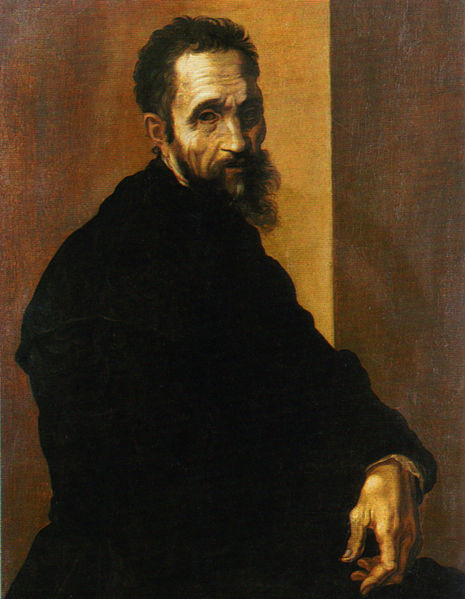
MICHELANGELO BUONARROTI (Michelangelo) (1475-1564) - architect, sculptor, poet & painter, was born in the small & remote village of Caprese, in the mountains about 90km east of Florence. His family moved to Florence soon after his birth & settled there permanently.
He started his artistic career with a (late) apprenticeship with Ghirlandaio, at around 13, but left within a year, partly because he had nothing to learn & partly because he was showing a marked preference for sculpture (a bias that remained with him all his life).
Michelangelo quickly found himself in a charmed circle, working with a group of artists sponsored by Lorenzo the Magnificent. It was his first brush with patronage, a system whose constant demands – those of the Popes in Rome, those of the Medici in Florence – were to prove a source of lifelong frustration. Many of his works remained unfinished because of it.
At the same time, Michelangelo could be his own worst enemy. His personal habits were repulsive; he was consumed by worry, desperate to accumulate property, jealous of other artists & overambitious.
Fate was no kinder as political turmoil frequently intervened to disrupt his work. One such upheaval, the Medici’s exile in 1494, saw him leave Florence for Bologna. A little later he was in Rome where he produced Bacchus (Bargello), his earliest surviving large-scale sculpture (c1497). A year later, still in Rome, came the work which secured his reputation: the Pieta (1498), now in Rome’s St. Peter’s. The Accademia’s David, sculpted on his return to Florence in 1501, consolidated his position. This Florentine interlude also produced the Uffizi’s Doni Tondo, one of his rare excursions into easel painting. In 1505, he started work on murals in the Palazzo Vecchio (of which only copies survive) & also began a set of 12 Apostles for the Duomo (of which only the Accademia’s St. Matthew was ever started). Both projects were abandoned so that he could work on the tomb of Pope Julius II in Rome – a proposed 40-figure sculpture that distracted him intermittently for almost 50 years. Soon after he began that project came his most famous commission, the painting of the Sistine Chapel (1508-12).
By 1516, he was back in Florence, dispatched by Leo X (a Medici Pope) to work under the Pope’s cousin, Cardinal de’Medici (later Pope Clement VII). During this period though turning increasingly to architecture, he embarked on San Lorenzo’s Medici tombs (1523-33), yet another unfinished work. Chastened by the Republic’s overthrow, he also helped to design the city fortifications before the siege of Charles V.
Michelangelo finally left Florence in 1534 & spent the rest of his days in Rome. During this period he wrote the best of his 300 or so poems. He also painted the Sistine Chapel’s Last Judgment (1534-41), its tone more subdued than that of his earlier work in the vaults.
Architecture again dominated as old age encroached; Piazza del Campidoglio & the dome of St. Peter’s were the 2 great works of his later years. Two tortured sculptures also materialized, one of which – the Pieta in the Museo dell’Opera del Duomo – was intended for his tomb. He died at the age of 88 & was buried in Florence’s Santa Croce.
(Michelangelo also was the architect of the Biblioteca Medicea Laurenziana (Laurentian Library). Here it is almost as if Michelangelo purposely set out to defy his predecessors, intentionally flouting the conventions of the High Renaissance to see what kind of bizarre, mannered effect might result. His innovations were extremely influential & produced a period of architectural experimentation, known as Mannerism, that eventually evolved into the baroque.)
MICHANGELO IN FLORENCE
Sculpture – Madonna della Scala, Battle of the Centaurs, Torso (Casa Buonarroti)
Bacchus, Madonna & Child tondo, Brutus (Bargello)
David, St. Matthew, Four Slaves (Accademia)
Lorenzo, Dawn & Dusk, Giuliano, Day & Night, Madonna & Child (Cappelle Medicee)
Pieta (Museo dell’Opera del Duomo)
Architecture – Sagrestia Nuova (Cappelle Medicee)
Biblioteca Laurenziana (San Lorenzo)
Paintings & drawings – Doni Tondo (Uffizi)
Drawings (Casa Buonarroti)
Graffiti & wall drawings (attributed to Michelangelo; Sagrestia Nuova, Cappelle Medicee).
Please see my next blog where I will cover the Medici family.
References
Wikipedia, the free Encyclopedia, 2011, Michelangelo, Wikipedia, the free Encyclopedia, Viewed 26 September 2011, http://en.wikipedia.org/wiki/Michelangelo
Please see my next blog where I will cover the Medici family.
References
About.com Art History, 2011, Michelangelo Buonarroti, About.com, viewed 1 October 2011,
http://arthistory.about.com/cs/namesmm/a/michelangelo.htmWikipedia, the free Encyclopedia, 2011, Michelangelo, Wikipedia, the free Encyclopedia, Viewed 26 September 2011, http://en.wikipedia.org/wiki/Michelangelo
Bonner, Neil R., Michelangelo Buonarroti Website, 2001, Early Life, Michelangelo.COM, Inc., viewed 3 October 2011, http://michelangelo.com/buonarroti.html
Lombardi, Matthew, 2006, Italy, Fodor's, New York.

No comments:
Post a Comment